CalmandStrong
Nothing is More Powerful Than a Made up Mind

“Thus politically, but far more intellectually, was Songhay (Songhai) restored to its ancient position as a child of Egypt (Kemet).”
– Flora Shaw (Lady Lugard)

“Not to know is bad, not to wish to know is worse.” – African Proverb
About 93% of the present-day African Americans came from the Western Sudan in West Africa, which was where the Songhai Empire was located during the 15th and 16th centuries in medieval times before the Transatlantic slave trade era.
“Songhay’s (Songhai’s) greatness was due to something more than the remarkable expansion of its empire over a territory larger than the continent of Europe. That was great, but greater by far was the grand scale on which the revival of learning spread among the Blacks of West Africa─The Western Sudan, or 'Land of the Blacks.' Three of the principal centers of learning were Jenne, Gao, and Timbuktu.”
- Dr. Chancellor Williams
The Kingdom of Timbuktu during the 16th century (West Africa)
According to Songhai writers, the kingdom of Timbuktu under Songhai rule was equivalent to the present-day United States of America cities of Chicago and New York, and Paris, France all combined and blended into an African setting.
“You must tell the story of our ancestors, the Songhai people." - Dr. Luther P. Jackson
The Songhai Empire was known as the "Land of Gold," that was ruled by the "Lords of Gold." The Songhai people supplied 80% of the world's gold for several centuries, and they ruled West Africa for 129 years.
The Songhai Empire consisted of parts of seven present-day countries in West Africa, and they are The Gambia, Guinea, Mali, Mauritania, Niger, Northern Nigeria, and Senegal.
“That the strength and greatness of the African people can be measured by how, in the face of what at times seemed to be all the forces of hell, they fought through to survive it all and, rebuilt kingdoms and empires some of which endured a thousand years. That within the framework of even the smallest surviving states they adhered to and kept alive the basic principles of traditional African constitution and held on through all the passing centuries to the fundamental elements of its ancient democratic, social, political and economic systems all over the continent; that Africa was the cradle of a religious civilization based on the conception of one Supreme God, Creator of the Universe.”
- Dr. Chancellor Williams
To find out more about the Great Songhai Empire, the last great nation of medieval West Africa before the Transatlantic slave trade era, and the birth and creation of African Americans, click here: The Birth & Creation of African Americans
“Narration describes the lives of lost tribes in the ghetto tryin’ to survive.”
– Nas
As direct descendants of the Songhai Empire, African Americans (i.e., about 93%) carry in their genes the creativity, resourcefulness and genius of their ancestors from this great medieval West African nation.
The ancestors of African Americans were held captive and forced to work from sunup to sundown for 10 generations without a payday for 300 years. On top of that, harsh laws were created and imposed on African Americans, which restricted them the opportunity to read and write, because if they were caught doing either, it was a death sentence. African Americans, most of whom are the children of the Songhai Empire have been subjected to the greatest trauma in the history of mankind. Only the strong survived during the unrelenting European Transatlantic slave trade era, and most African Americans living in Western civilization during the modern era are the children of the mighty Songhai Empire.
By the European colonial era in the early 1800s, European powers had stripped the Songhai Empire of its human population. This West African nation that most of the ancestors of African Americans once called home (i.e., the land of gold) looked like a barren wasteland. Not just the human population of the Songhai Empire was stripped by Europeans, because they also plundered resources, like the Songhai's gold, because between the 15th and 17th centuries, Europeans discovered an even greater source of gold in Central and South America.
This set off the beginning of the foundation of the "New World," (i.e., the Americas) that was "so-called" discovered by European explorers (i.e., invaders, exploiters, and colonizers) like Christopher Columbus, because the "Old World" (i.e., Africa) had been forgotten, except for "The Destruction of Black Civilization," and the "human trafficking" of Black people who were made to be slaves in the American and European continents.
The Great Songhai Empire was invaded by the Moroccans (Morocco: present-day Northwest Africa) with their hired European (i.e., English and Spanish) mercenaries in 1591. From the fall of the Songhai Empire in 1591 to 1858, various authorities of history agree that upwards of 100 million Black people were taken out of Africa as prisoners-of-war. This means that the citizens of the Songhai Empire (about 93% of the ancestors of the present-day African Americans came from the Songhai Empire, and their country was also the same size as all of Europe combined during the 16th century before the Transatlantic slave trade era) were never slaves. They were prisoners-of-war and were made to be slaves by their European captors and slave masters.
According to Dr. Anthony T. Browder, author of Nile Valley Contributions to Civilization: Exploding the Myths Vol. 1, although the total number of African people stolen from Africa varies from source to source, but it has been estimated that a minimum of 50 million African people were displaced from the Transatlantic slave trade era, and the estimated deaths are more than 80 million African people.
“Sociologists, psychiatrists, and psychologists have all agreed that no other ethnic group has had to endure what the African has endured. In control groups, where tests have been made for comparatively short durations, white subjects went almost completely insane when they were subjected to only a fraction of the horrors that Blacks are subjected to, and have been subjected to for more than three centuries.”
- Dr. Calvin R. Robinson, Dr. Edward W. Robinson and Redman Battle, authors of The Journey of the Songhai People
Considering the degree to which the European enslavers and captors went, to dehumanize and robotize the ancestors of African Americans in the United States of America, and the Blacks taken to other regions of Western civilization, it is a “wonder” that these Blacks survived at all, because there were no limits to the cruelties and humiliations that were forcefully imposed upon the African captives by the European enslavers and captors code laws. Historian Stanley Elkins concluded that the whites had succeeded in reducing Black people to the level of dependency of infants. These tactics weren’t just used in the U.S. but also throughout Africa during the era of European colonial rule.
The enslavement of Africans by non-Africans was based solely on race and greed.
“Certainly, I knew from reading all about the ‘Rape of Africa,’ but to know the scale on which this was done one must see at least some of it in Europe with his own eyes—and be amazed. The museums in various cities of the European colonial powers are repositories of much African history.”
– Dr. Chancellor Williams
These actions have had a demoralizing domino effect on the African continent and Black people, because Africa’s human and natural resources had been stripped by the European invaders. While destroying ancient and medieval African civilizations, the European invaders, backed with their specific European governments were able to simultaneously develop their motherland of Europe and their colonies in the Americas.
Apart from the Indian Native Americans (the Americas) and the Aboriginal Australians (Oceana), there is no other people on Earth, besides African people, who had their continent stolen from them by foreigners and have been enslaved and exported to other continents (i.e., Europe and the Americas) by the millions. The European Transatlantic slave trade was an inhumane (i.e., crime against the African branch of humanity) commercial revolution that gave birth to Western (European) civilization and the modern world as we know it today.
The phenomenal success of Western civilization in war for hundreds of years has elevated the elites of this civilization to an unquestionable “position of strength.”
"The invaders raiding into the continent (Africa) from Asia and Europe formed the second centuries-long battlefronts against which the Blacks had to fight for survival. These wars spanned several thousand years, and in an earlier chapter (The Destruction of Black Civilization) I ‘wondered out loud’ ─how any people, weakened by perpetual hunger and disease, could possibly carry on wars of resistance to the white invaders for over 5,000 years. This they did─and this their descendants must know and remember with pride: That Black resistance to white domination covered over 5,000 years.”
– Dr. Chancellor Williams
Black people, both Continental and Diaspora Africans are still experiencing the repercussions from the events of the European Transatlantic slave trade and European colonization. Before the European Transatlantic slave trade era, Black people, which includes some of the ancestors of the present-day African Americans, Afro Caribbeans, Afro Latinos, etc. experienced a “Golden Age” during medieval West Africa (i.e., the Songhai Empire). From the events of the European Transatlantic slave trade era, starting from the 15th century to the present-day 21st century, Black people, both Continental and Diaspora Africans have been forced to experience a brutal “Dark Age.”
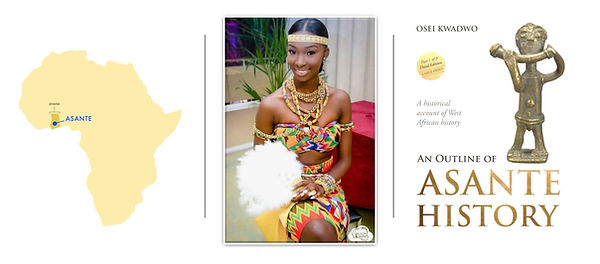
West Africa's Golden Coastal Empire: The Asante Empire
Osei Bonsu was one of the kings of the Asante Empire, which was one of the wealthiest nations in the history of Africa before European conquest and colonization. The Asante Empire was rich because it sat atop enormously rich deposits of gold. For example, so many speckles of gold naturally washed down the rivers to the Atlantic Ocean, and this was why the British, the Europeans who conquered and colonized the Asante Empire renamed the country the “Gold Coast” (present-day Ghana, West Africa).
African independence finally swept throughout the African continent starting with the Gold Coast (present-day Ghana, West Africa, formally the Asante Empire) in 1957, and the last African country to free itself from the yoke of European colonization was the nation of South Africa in 1994.
The success of Western civilization is an illusion, and a perfect example that sometimes victors of history are not always the bearers of truth, especially when one of the European (i.e., British) slave ships was given the infamous name of the “Jesus,” which was led by Englishman Sir John Hawkins who commanded his sailors to “serve God daily and love one another.” Not only did they conquer Africa's lands, but they also conquered Africa's histories. Western civilization might have brutally ended Africa's ancient and medieval civilizations; but although they tried, the elites of Western civilization never destroyed Black people's spirit, because Black people, Africa's Continental and Diaspora people are the "Spirit People," and descendants from the "Land of the Gods." The sacred soil of Africa’s mainland and islands always remembers the greatness and potential of her melanated children... Always.
West African Civilizations Falls by the Hands of Western (European) Civilization




Africa (Alkebu-lan): The Land of the Spirit People & Land of the Gods

“For nothing seems clearer from ancient records than that the whole ancient world knew of nothing more ancient than the Black man’s civilization."
- Dr. Chancellor Williams, author of The Destruction of Black Civilization: Great Issues of a Race From 4500 B.C. to 2000 A.D.
“Givin’ every particle is all I know. I let the thoughts I float bomb the globe without harmin’ folks. Full body armor on, I walk alone and talk with poems."
– Blu & Exile

Darryl C. Richie
A Mystic Wonder's Mentality with the Soul of a Philosopher Poet
“Hol’ on, I see nuff faces long, but this is not a racist song. This is a song for the children who was never told about where their race is from.”
– Chronixx

Africa (Alkebu-lan): The Land of the Spirit People & Land of the Gods

The Songhai Empire (Medieval West Africa, 15th and 16th centuries)
“. . . The first, and perhaps the most important fact is that the general enslavement of Africans, proclaimed to the world as savages, began during the very period and in the very West Africa in the center of which one of the great universities of the world and
other colleges were located.”
– “The Black Revival of Learning,” p. 247

.jpg)

Disclaimer and Sources...
Adebajo, A. The Pan-African Pantheon: Prophets, Poets, and Philosophers. Manchester University Press; 1st edition. (March 29, 2021). Nov. 13, 2025. p. 25, 34, 214, 484.
Akintoye, S. A History of the Yoruba People. Amalion Publishing. (Jan 1, 2010). Nov. 28, 2025. p. 589.
Battle, R., Robinson, C., Robinson, E. The Journey of the Songhai People. Pan African Federation Organization; 2nd edition.(June 1, 1992). Nov. 10, 2025. p. 8, 14-15, 19, 150, 170, 244, 251, 262, 268, 271, 353.
Bennett, L. Before The Mayflower: A History of The NegroinAmerica,1619-1962.Ebooks for Students, Ltd.(January 6,2021). Nov. 10, 2025. p. 35.
Bonaparte, F., Robinson, E. No Man Can A-Hinder Me: A Message of Defiance From My Plantation Mothers and Fathers. CreateSpace Independent Publishing Platform. April 6, 2012. Nov. 14, 2025. p. Cover, 38, 103.
Browder, A. Nile Valley Contributions to Civilization: Exploding the Myths Vol. 1. The Institute of Karmic Guidance; First Edition. (Dec. 1, 1992). Nov. 14, 2025. p. 258-260.
Brown, C. Black Love Art. Chabutta Brown. Pinterest. Nov.16, 2025. https://www.pinterest.com/pin/767934173944912970/sent/?invite_code=c9be33711e3d4c72864bfef3774c53f3&sender=690739799006539387&sfo=1
Captivating History. The Songhai Empire: A Captivating Guide to One of the Largest States of Medieval West Africa (Western Africa). Captivating History. March 4, 2022. Nov. 11, 2025. p. 6, 23, 56.
Carlo, M. Three Sudanic States Ghana Mali Songhai. Slide Serve. Oct. 24, 2011. Nov. 10, 2025. https://www.slideserve.com/MikeCarlo/three-sudanic-states-ghana-mali-songhai
Edgerton, R. Africa’s Armies: From Honor to Infamy. Basic Books. (March 25, 2009). Dec. 22, 2025. p. 48.
Genius. Blu & Exile. Love is Blu. Love (the) Ominous World. Genius. Sept. 20, 2024. Nov. 12, 2025. https://genius.com/Blu-and-exile-love-is-blu-lyrics
Genius. Chronixx. Black is Beautiful. Chronology. Genius. July 7, 2017. Nov. 12, 2025. https://genius.com/Chronixx-black-is-beautiful-lyrics
Genius. Nas. Stillmatic (The Intro). Stillmatic. Genius. Dec. 18, 2001. Nov. 16, 2025. https://genius.com/Nas-stillmatic-the-intro-lyrics
KarnRedsun. File:Songhai Empire (orthographic projection).svg. Wikimedia Commons. Sept. 21, 2009. Nov. 10, 2025. https://en.m.wikibooks.org/wiki/File:Songhai_Empire_%28orthographic_projection%29.svg
Kwadwo, O. An Outline of Asante History Part 1 of 3 Third Edition: A historical account of West African history (An Outline of Asante Traditions). Publishing House of Poku; 3rd edition. (October 24, 2022). March 25, 2026. p. Cover.
Linda, M. Asante woman image. Meme Linda. Pinterest. March 25, 2026. https://www.pinterest.com/pin/107101297373878510/
Minneapolis Institute of Art. Sante Kente Cloth. Minneapolis Institute of Art. March 25, 2026. https://new.artsmia.org/programs/teachers-and-students/teaching-the-arts/artwork-in-focus/asante-kente-cloth
Ogundiran, A. The Yoruba: A New History. Indiana University Press. Nov. 3, 2020. Nov. 13, 2025. p. 300.
Rodney, W. How Europe Underdeveloped Africa. Verso. (Nov. 27, 2018). Feb. 20, 2026. p. 96.
Sertima, I. They Came Before Columbus: The African Presence in Ancient America. Random House. Sept. 23, 2003. Dec. 16, 2025. p. 56, 236.
Shaw, F. (Lady Lugard). A Tropical Dependency. Black Classic Press. (May 1, 1995). Nov. 11, 2025. p. 185.
Walker, R. When We Ruled: The Ancient and Mediaeval History of Black Civilizations. Black Classic Press. (May 1, 2011). Nov. 10, 2025. p. 55, 383-384, 390, 547, 565.
Williams, C. The Destruction of Black Civilization: Great Issues of a Race from 4500 B.C. to 2000 A.D. Third World Press; 3rd Revised ed. edition. (Feb. 1, 1992). Nov. 10, 2025. p. 20, 36, 80, 208, 217, 219, 315-316.