
Before Mount Rushmore in America: The Ancient & Medieval Wonders of Africa and Asia: “Mountains with Black Faces”

“Egypt was the place that Alexander the Great went. He was so shocked at the mountains with black faces.” – Nas

Image I (Top Left): The Benevolent & Compassionate Buddhist Warrior God-King Jayavarman VII of the Khmer Empire (Cambodia, Southeast Asia). He established a new capital, Angkor Thom, built a magnificent Buddhist temple called the Bayon, and there are 216 gigantic faces of the Khmer king on the temple that existed for hundreds of years from the late 12th to the early 13th centuries.
Ancient Kemet & the Medieval Khmer Empire Connection: The builders of the Angkor Kingdom were Africoid people known as the Khmers, a name that recalls Kmt (ancient Kemet, Egypt).
Image II (Bottom Right): Pharaoh Khafre depicted as the Great Sphinx of ancient Kemet (i.e., Egypt, Northeast Africa) existed for thousands of years from the Old Kingdom Period, between 5,000-2,500 BCE.
The most prominent and enduring kingdom of early Southeast Asia was Angkor (802-1431). The religion of this nation during different periods included Hinduism, Buddhism, and local animist beliefs. During the early 9th century, King Jayavarman II (802-850) founded Khmer Kingdom and unified his kingdom and identified himself with the powerful Hindu deity, Shiva. In 889, King Yasovarman I (889-900) constructed his capital city at the current site of Angkor. It was King Yasovarman I’s successors who were responsible for the foundation of what eventually became Angkor Wat, which has been called “the largest stone monument in the world.”
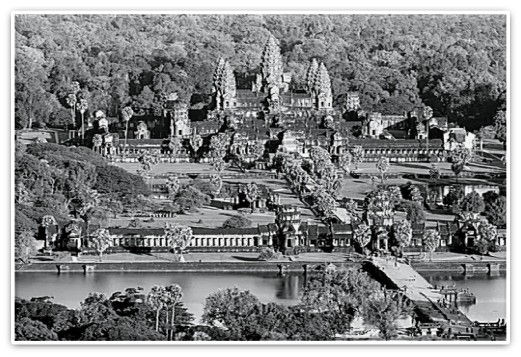
The Angkor Wat Temple dates from the 12th century reign of King Suryavarman II (1113-1150) when the Khmer Empire ruled Southeast Asia.
Aerial view of Angkor Wat, showing the moat and causeway and the center tower surrounded by four smaller towers.
“May the kings of Cambodia who come after me, attached to goodness…attain with their wives, dignitaries, and friends the place of deliverance where there is no more illness.” - King Jayavarman VII
The Benevolent & Compassionate Buddhist Warrior God-King Jayavarman VII of the Khmer Empire (Cambodia, Southeast Asia)
– Nan Ts’i Chou

The reign of King Jayavarman VII (1181-1220) was established as Angkor’s most prolific builder, and he marked the height and beginning of the decline of the Kingdom of Angkor. King Jayavarman VII (the prefix of whose name, Jaya, in Sanskrit, means (“victory”) was said to have been a compassionate king as it pertained to his subjects.
For instance, King Jayavarman VII was famous for establishing “hospital temples,” and he constructed 102 of them, in which the average citizen could have ailments cared for. He seemed to be altruistic and had genuine concern for the welfare of all the people in his country, and not just a particular class because a 12th century inscription about the king at one of the hospitals read:
“He (King Jayavarman VII) suffered the illnesses of his subjects (citizens) more than his own; because it is the pain of the public that is the pain of kings rather than their own pain.”
The Bayon, an Angkor temple in the Kingdom of Angkor Thom was only second to Angkor Wat in size. The 800-year-old shrine is celebrated for its gigantic 216 stone faces of the Khmer king and its founder, King Jayavarman VII.
After the death of King Jayavarman VII, the Khmer Empire began to decline, and no great monuments were constructed after his benevolent reign as the king of Angkor. During the 15th century, the Khmer Empire was on the verge of collapse due to a series of Thai invasions.
Pharaoh Khafre depicted as the Great Sphinx of ancient Kemet (i.e., Egypt, Northeast Africa)
The Great Sphinx of Giza is a portrait of Pharaoh Khafre and is one of the grandest showpieces of early African technology and one of the largest statues ever made. The head of a Man and the Body of the Lion symbolize the triumph of the mind over Man’s lower animal nature.

During the ancient world, Africa or Alkebu-lan had many names, like the “Land of the Spirit People,” the “Land of the Gods” and the “Land of the Blacks,” which was not only the “Cradle of Civilization,” but African (Black) people were once the leading people on Earth. Ancient Egypt was not only once all Black, but even the name “Egypt” was derived from Black people.
On the authority of Dr. Chancellor Williams, author of The Destruction of Black Civilization: Great Issues of a Race from 4500 B.C. to 2000 A.D., there was no “Egypt” before the Black king from whose name it was indirectly derived from. Before the country was called “Egypt,” it was called “Chem” or “Chemi” (Kemet, i.e., “Black land” or “Land of the Blacks”), another name indicating its Black inhabitants.
What Happened?
“But the Assyrians, Hebrews, Greeks and Romans could make no such claim to support the myth of Caucasian superiority. For nothing seems clearer from ancient records than that whole ancient world knew nothing more ancient than the Black man’s civilization.” – Dr. Chancellor Williams
The ancient Greeks seemed to have studied the advanced civilization of Black people more than any other white people, because they were the first who regarded Black people as superior people. The question about inherent inequality would have been absurd to entertain by the ancient Greeks.
There were ancient white people who were affectionately drawn towards ancient Black people as by some magic. When the ancient Blacks recognized this as genuine, the esteem became mutual and some ancient whites even became an integral part of some ancient Black groups. These ancient Greeks, and some other ancient whites were a small minority, who stayed with and fought alongside Black people, shoulder to shoulder against their own kind, Caucasian or European people. These whites retreated with the Blacks in defeat, and were, therefore, a part of the Black’s migrations. Also, not all mixed Africans, like Afro-Asian or Afro-European people deserted the Blacks for the whites. Although a great majority of mixed African people did cleave to the race of their fathers (i.e., European or Asian), but some of these offsprings were devoted to their African mother’s and seemed to be very spiritual in nature.
The Assyrians (Asia), Hebrews (Asia), Greeks (Europe), Romans (Europe), and many others invaded, conquered, and colonized ancient Egypt during different periods of the ancient world. These groups from Asia and Europe were attracted and threatened by Black people’s wealth that was known as the “Bread Basket of the Nile.” Although the invasion of the African continent from the people of Asia and Europe began during the ancient world, but unfortunately for the Blacks, the successful infiltration by some European nations and Saudi Arabia into African kingdoms and empires for complete domination and conquest of Africa was carried over from the ancient world to the medieval world.
Some nations of Europe, like England, France, Germany, Portugal, etc. and Saudi Arabia took things a bit further by making the human trafficking of Black people legal through their Arab Trans-Saharan slave trade during the 7th century, and their European Transatlantic slave trade during the 15th century. Millions of Black people died, and millions of Black people were taken out of Africa to different parts of the world to work for free as enslaved people. Through this enslavement, Black people made some nations of Europe and Saudi Arabia wealthy countries, and this wealth could easily be seen during the modern era in the many countries of Western (European) civilization, which includes the United States of America, and Saudi Arabia in Asia.
The Portuguese, to their great surprise, had to fight their longest and bloodiest war, almost foot by foot, before they took Angola (an African country in present-day Southwest Africa) as a colonial possession a half a century later. They had not counted on being confronted by a Black warrior queen who turned out to be one of the bravest generals to ever command an army. What’s her name? The “Unconquerable” Queen Ann Nzinga.
Resistance to White Rule in Africa: Queen Ann Nzinga of the Ndongo & Matamba Kingdoms (Southwest Africa)
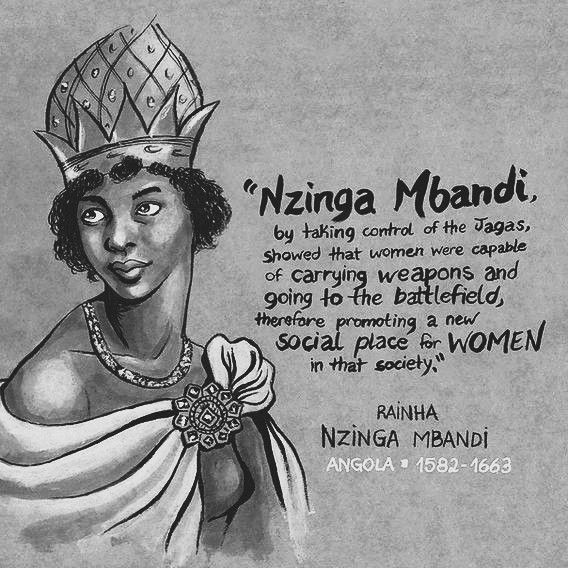
“Nzinga’s greatest act, however—and probably the one that makes her one of the greatest women in history—was in 1624 when she declared all territory in Angola over which she had control as a Free Country, all slaves reaching it from whatever quarter were forever free. She went further. Since it was clear to her that White Power in Africa rested squarely on the use of Black troops against Black people, she undertook the first and only carefully organized effort to undermine and destroy the effective employment and use of Black soldiers by whites—the first and only Black leader in history who was ever known to undertake such a task.” – Dr. Chancellor Williams

It took the European invaders over 5,000 years to successfully conquer and colonize Africa. The consequence from the successful conquest of Africa from its indigenous people meant that African (Black) people no longer had their indigenous nations to govern or their continent, Africa, to call home anymore when some Black people were forcefully exiled to different regions of the Americas and Europe as enslaved people for hundreds of years. The exiled Africans weren’t regarded as human beings, and they became a race of outcasts hating themselves for just being alive. The Caucasian triumph was complete.
Mountains with Black Faces: Part II
“Anytime you see an ancient status (statue) with a missing nose, its nose probably looked like a Black nose. Some statues even have their lips broken off.” – Dr. Supreme Understanding, author of When The World Was Black Part Two: The Untold History of the World’s First Civilizations: Volume Two of the Science of Self: Part Two: Ancient Civilizations

Central portion of the Bayon temple, Angkor. Constructed by Jayavarman VII in the 12th century.
“The noses of people and the lips of people, more than any other part of the face tells you ‘Ethnically’ who they belong to. You can't debate once you look at the nose and the lips. You can't debate who he is. You know that's one of your (African, Black) children.” - Dr. John Henrik Clarke

“I felt that I had a peculiar heritage in the Great Pyramid built…by the enterprising sons of Ham, from which I descended….I felt lifted out of the commonplace grandeur of modern times; and, could my voice have reached every African in the world, I would have earnestly addressed him…: ‘Retake your fame.” - Intellectual and Activist Dr. Edward Wilmot Blyden
America’s Mount Rushmore

King Jayavarman VII of the Khmer Empire established Angkor Thom, and the Bayon, a Buddhist temple built in the likeness of the Khmer king from the late 12th to early 13th centuries. The Great Sphinx in ancient Kemet (i.e., Egypt) was built in the likeness of Pharaoh Khafre, which was from the Old Kingdom Period, between 5,000-2,500 BCE.
The 216 faces of King Jayavarman VII in Angkor Thom, in present-day Cambodia existed for 800 years, and the Great Sphinx of ancient Kemet (i.e., Egypt) of Pharaoh Khafre existed between 6,900 and 4,400 years.
"Mountains with Black Faces" existed in the Khmer Empire (Southeast Asia) for hundreds of years before Mount Rushmore in America, and ancient Kemet (Northeastern Africa) for thousands of years before Mount Rushmore in America.
Sources:
Adebajo, A. The Pan-African Pantheon: Prophets, Poets, and Philosophers. Manchester University Press; 1st edition. (March 29, 2021). Aug. 1, 2026. p. 31.
Ashby, M. Kemetic Diet: Ancient African Wisdom for Health of Mind, Body and Spirit: Based on the Natural Diet and Health System of Ancient Kamit and Nubia. Sema Institute. (May 29, 2011). July 31, 2026. p. 186.
Battle, R., Robinson, C., Robinson, E. The Journey of the Songhai People. Pan African Federation Organization; 2nd edition. (June 1, 1992). July 31, 2026. p. 15, 70.
Browder, A. Nile Valley Contributions to Civilization: Exploding the Myths Vol. 1. The Institute of Karmic Guidance; First Edition. (Dec. 1, 1992). July 31, 2026. p. 225.
Captivating History. A Captivating Guide to the History of Cambodia and the Khmer Empire. Captivating History. April 19, 2021. July 31, 2026. p. 30-31.
Captivating History. History of Southeast Asia: A Captivating Guide to the History of a Vast Region Containing Countries Such as Cambodia, Laos, Thailand, Singapore, Indonesia, Burma, and More. Captivating History. March 1, 2021. July 31, 2026. 16-17.
Clarke, J. Garvey, A. Rashidi, R. Marcus Garvey and the Vision of Africa. Black Classic Press. (May 15, 2016). July 31, 2026. p. 6.
Contributed Content. The Story of Mount Rushmore, and a country in transition. The Press Democrat. July 3, 2009. July 31, 2026. https://www.pressdemocrat.com/2009/07/03/the-story-of-mount-rushmore-and-a-country-in-transition/
Dr. Supreme Understanding. When The World Was Black Part Two: The Untold History of the World’s First Civilizations: Volume Two of the Science of Self: Part Two: Ancient Civilizations. Supreme Design Publishing. (Feb. 14, 2017). July 31, 2026. p. 221.
Genius. Nas. I Can. God’s Son. Genius. Feb. 11, 2003. July 31, 2026. https://genius.com/Nas-i-can-lyrics
History. Deconstructing History: Mount Rushmore | History. YouTube. June 20, 2014. Aug. 1, 2026. https://www.youtube.com/watch?v=CHMDDpk12Bo
History. The UnXplained: Mysteries of the Sphinx (Season 3) | History. History. YouTube. April 4, 2022. Aug. 1, 2026. https://www.youtube.com/watch?v=zGNctMdQuNI
Jarus, O. Angkor Wat: History of Ancient Temple. Live Science. April 5, 2018. July 31, 2026. https://www.livescience.com/23841-angkor-wat.html
Jimerson, R. The Greatness of Black India: Out of Nubia/Kemet to Overcoming White Supremacy. Dr. Rufus O. Jimerson. Aug. 6, 2021. Aug. 1, 2026. Location: 1039.
Landlopers. Angkor Thom ─ The Real Star of Cambodia’s Temples. Landlopers. July 23, 2014. July 31, 2026. https://landlopers.com/2014/07/23/angkor-thom
Orth, Z. Series: Women, Power and Politics in Africa. Nzinga, Queen of Angola. Africa Matters Initiative. April 11, 2018. Aug. 4, 2026. https://www.africamattersinitiative.com/post/2018/04/11/series-women-power-and-politics-in-africa-nzinga-queen-of-angola
Rashidi, R., Sertima, I. African Presence in Early Asia. Transaction Publishers. (June 15, 1986). March 4, 2021. p. 331-332, 334, 337, 341, 349.
Seni World. Angkor Thom: The Great City of the Khmer Empire | 2025 Guide. Seni World. YouTube. Oct. 16, 2025. Aug. 1, 2026. https://www.youtube.com/watch?is=YgwIi3YBYVsgmkl6&v=1kz3kpwuKTA&feature=youtu.be
TV108 - The Black Side. Dr. John Henrik Clarke | Empire of Songhai. TV108 – The Black Side. YouTube. Feb. 17, 2017. July 31, 2026. https://www.youtube.com/watch?v=s6qn0K1wLPM&t=3019s
Walker, R. When We Ruled: The Ancient and Mediaeval History of Black Civilizations. Black Classic Press. (May 1, 2011). Aug. 1, 2026. p. 547.
Williams, C. The Destruction of Black Civilization: Great Issues of a Race from 4500 B.C. to 2000 A.D. Third World Press; 3rd Revised ed. edition. (Feb. 1, 1992). July 31, 2026. p. 18, 36, 41, 68, 72-73, 77, 80-81, 155-156, 190, 260, 274-276, 282-283, 285, 289.


Comments